
Chord inversions alter the order of major and minor chords and use either the 3rd or 5th of the chord as the lowest note. Learn some of the most commonly used open chord inversions and how they are used in chord progressions.




Course Homepage
Open Chord Inversions
Open Chords Turned Upside Down
Chord inversions alter the order of major and minor chords and use either the 3rd or 5th of the chord as the lowest note. Learn some of the most commonly used open chord inversions and how they are used in chord progressions.
Open Chord Inversions: Lesson 1
Introduction to Chord Inversions
Chord Inversions
Up to this point, each chord we have learned has had the root of the chord as the lowest note. These chords are said to be in root position. A chord inversion is a chord that has either the 3rd or 5th (or 7th with seventh chords) of that chord as its lowest note. A first Inversion chord has the 3rd of the chord in the bass and a second inversion chord has the 5th of the chord as the lowest note. Any major or minor chord can have two inversions, while 7th chords can have three inversions.
The chord symbol for a C/G chord, which is a C major chord with a G note in the bass.
Chord inversions are notated with two notes separated by a backslash. The letter before the backslash determines the chord, while the letter to the right of the backslash denotes the bass note of that chord.
C major chord with chord inversions.
Open Chord Inversions: Lesson 2
The C/E Chord
Chord Inversions: The C/E Chord
The C/E Chord
The C/E Chord
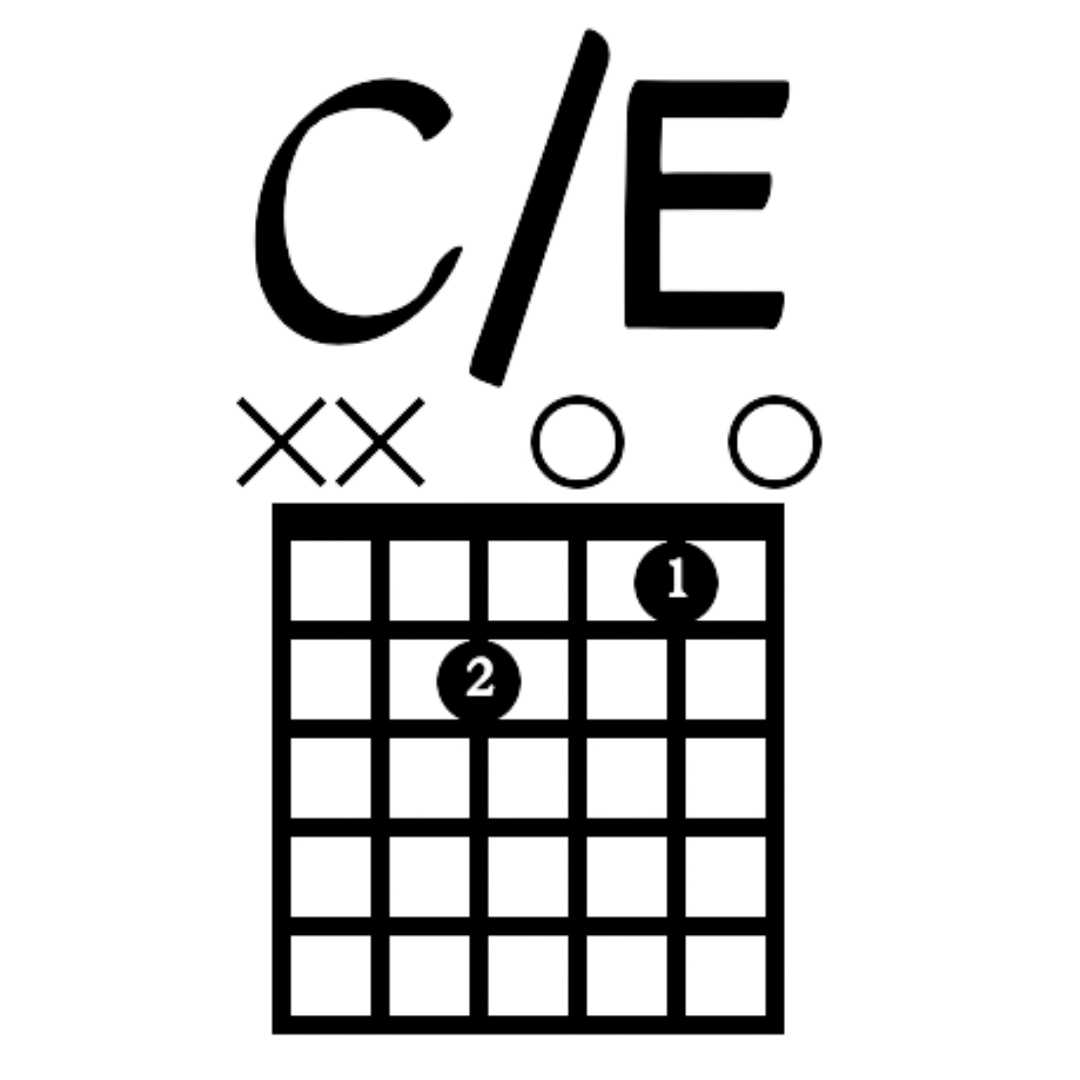
The C/E chord is the first inversion of a C major chord. The C/E chord contains the 2nd fret of the 4th string (E), the open 3rd string (G), the 1st fret of the 2nd string (C), and the open 1st string (E). The notes in our C/E chord are the same as our C major chord (C, E, and G), but with the E as the lowest note.
How to Play the C/E Chord
Place your 2nd finger on the 2nd fret of the 4th string.
Place your 1st finger on the 1st fret of the 2nd string.
Open Chord Inversions: Lesson 3
The D/F# Chord
Chord Inversions: The D/F# Chord
D/F# Chord - Full Version
D/F# Chord - Alternate Version
D/F# Chord - Full Version
The D/F# chord is the first inversion of a D major chord. The D/F# chord contains the 2nd fret of the 6th string (F#), the open 5th string (A), the open 4th string (D), the 2nd fret of the 3rd string (A), the 3rd fret of the 2nd string (D), and the 2nd fret of the 1st string (F#).
The notes in our D/F# chord are the same as our D Major chord (D, F#, and A), but with the F# as the lowest note. Place your 1st finger on the 2nd fret of the 6th string.
It is also common to omit the 1st string on this chord by muting it. This is done in the alternate version of the D/F# chord.
How to Play the D/F# Chord
Place your 1st finger on the 2nd fret of the 6th string.
Place your 2nd finger on the 2nd fret of the 3rd string.
Place your 4th finger on the 3rd fret of the 2nd string.
Place your 3rd finger on the 2nd fret of the 1st string.
Open Chord Inversions: Lesson 4
Moving Between C/E and D/F# Chords
Moving Between Chords: C/E and D/F#
The D/F# Chord

The C/E Chord

The D/F# Chord

The C/E Chord
With each new chord that we learn, start practicing switching between the chords by strumming whole notes at 60bpm. The goal with these exercises is to play in time but allow for a substantial amount of time to learn to switch the chord and stay in time with the metronome.
It is very important to move from the lowest string to the highest string, so you should always place the lowest note of the chord down first and work up the strings from there.
When comfortable switching chords using whole notes, try to move on to the next exercise using half notes, which are strummed every two beats.
Finally, we will practice our main goal, which is to switch chords effectively and repeatedly while strumming quarter notes in the right hand.
All of the exercises below should be played with downstrokes only.
Exercise 1 - Whole Notes (4 beats Per Measure)

Exercise 2 - Half Notes (2 beats Per Measure)

Exercise 3 - Quarter Notes (1 beat Per Measure)
Open Chord Inversions: Lesson 5
The C/G Chord
Chord Inversions: The C/G Chord
The C/G Chord
The C/G Chord
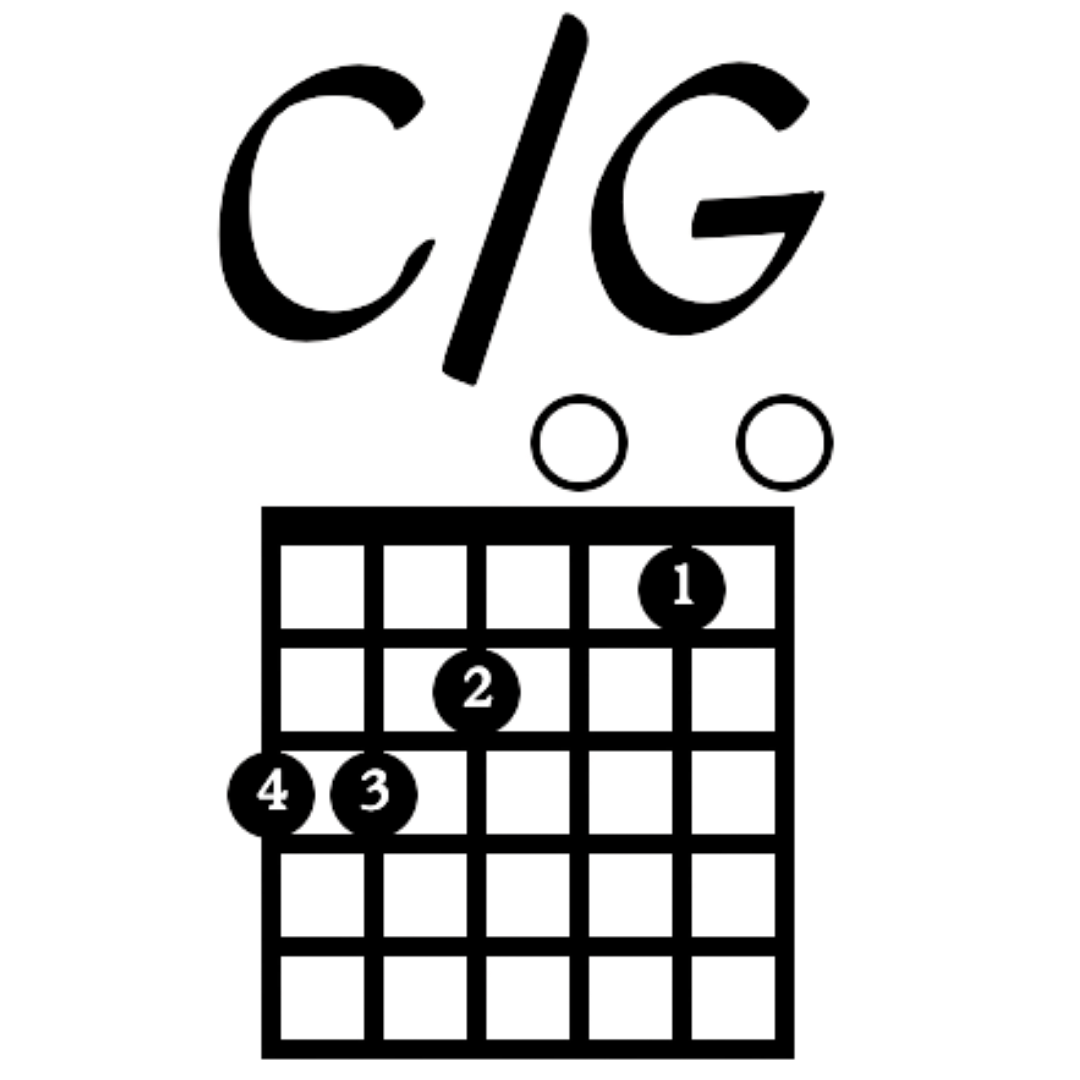
The C/G chord is the second inversion of a C major chord, with the note G as the lowest note of the chord. The C/G chord contains the 3rd fret of the 6th string (G), the 3rd fret of the 5th string (C), the 2nd fret of the 4th string (E), the open 3rd string (G), the 1st fret of the 2nd string, and the open 1st string (E).
How to Play the C/G Chord
Place your 3rd finger on the 3rd fret of the 6th string.
Place your 4th finger on the 3rd fret of the 5th string.
Place your 2nd finger on the 2nd fret of the 4th string.
Place your 1st finger on the 1st fret of the 2nd string.
Open Chord Inversions: Lesson 6
The G/B Chord
Chord Inversions: The G/B Chord
The G/B Chord
The G/B Chord
The G/B chord is the first inversion of a G major chord. The G/B chord contains the same notes as the G major chord (G, B, D), but contains the 3rd (B) in the bass. The G/B chord contains the 2nd fret of the 5th string (B), the open 4th string (D), the open 3rd string (G), the 3rd fret of the 2nd string (D), and the 3rd fret of the 1st string (G).’/How to play the G/B chord:
Place your 1st finger on the 2nd fret of the 5th string.
Place your 3rd finger on the 3rd fret of the 2nd string.
Place your 4th finger on the 3rd fret of the 1st string.
Open Chords: Lesson 7
Moving Between C/G and G/B
Moving Between C/G and G/B Chords

The G/B Chord

The C/G Chord
The G/B Chord
The C/G Chord
With each new chord that we learn, start practicing switching between the chords by strumming whole notes at 60bpm. The goal with these exercises is to play in time but allow for a substantial amount of time to learn to switch the chord and stay in time with the metronome.
It is very important to move from the lowest string to the highest string, so you should always place the lowest note of the chord down first and work up the strings from there.
When comfortable switching chords using whole notes, try to move on to the next exercise using half notes, which are strummed every two beats.
Finally, we will practice our main goal, which is to switch chords effectively and repeatedly while strumming quarter notes in the right hand.
All of the exercises below should be played with downstrokes only.
Exercise 1 - Whole Notes (4 beats Per Measure)
Exercise 2 - Half Notes (2 beats Per Measure)
Exercise 3 - Quarter Notes (1 beat Per Measure)
Open Chord Inversions: Lesson 8
Lesson 8: The F/C Chord
Chord Inversions: The F/C Chord
The F/C Chord
The F/C Chord
The F/C chord is the 2nd inversion of the F major chord, with the note C in the bass. the F/C chord contains the 3rd fret on the 5th string (C), the 3rd fret on the 4th string (F), the 2nd fret on the 3rd string (A), the 1st fret on the 2nd string (C), and the 1st fret on the first string (F). The F/C chord contains the same notes as the F Major chord (F, A, and C) but with the C in the bass.
How to Play the F/C Chord
Place your 3rd finger on the 3rd fret of the 5th string.
Place your 4th finger on the 3rd fret of the 4th string
Place your 2nd finger on the 2nd fret of the 3rd string.
Create a barre with your 1st finger on the 1st fret of the 2nd string and 1st string.
Open Chord Inversions: Lesson 9
Chord Inversion Review
Chord Inversions Review
The C/G Chord
The C/E Chord

The D/F# Chord

The G/B Chord
The F/C Chord
The F/C Chord
The G/B Chord
The C.E Chord
The C/G Chord
Exercise 1 - Whole Notes (4 beats Per Measure)
Exercise 2 - Half Notes (2 beats Per Measure)
Exercise 3 - Quarter Notes (1 beat Per Measure)
Open Chord Inversions: Lesson 10
Chord Progressions with Inversions
Chord Progressions with Inversions
The following chord progressions are some of the most common uses of chord inversions in popular guitar music. Practice each pattern with a strumming pattern of your choice and see how the use of inversions can connect the bass line melody in between chords.


Inversion Chord Progression #1

Inversion Chord Progression #2

Inversion Chord Progression #3 (Note the 3/4 Time Signature!)

Inversion Chord Progression #4 (Note the 3/4 Time Signature!)

In-Person and Online Guitar Lessons In Aliso Viejo, Anaheim, Brea, Buena Park, Costa Mesa, Cypress, Dana Point, Fountain Valley, Fullerton, Garden Grove, Huntington Beach, Irvine, La Habra, La Palma, Laguna Beach, Laguna Hills, Laguna Niguel, Laguna Woods, Lake Forest, Los Alamitos, Mission Viejo, Newport Beach, Orange, Placentia, Rancho Santa Margarita, San Clemente, San Juan Capistrano, Santa Ana, Seal Beach, Stanton, Tustin, Villa Park, Westminster, Yorba Linda